
Getting People on Board with AI
What baked beans can tell us about the workplace transformation
The human factor in AI adoption
Every AI initiative at virtually every company we talked to is unique in some way. From organizational setup to the technologies employed, to the central use case. But one struggle is the same across the board: the human factor.
It turns out, most people don’t like change. Especially if that change might mean that whatever they are good at and currently being paid for might just become irrelevant. Go figure. We’ve heard stories from workers actively sabotaging AI initiatives by manipulating data, providing false feedback, or straight up refusing to use the new tools available. On top of that, “Betriebsräte” act as the final boss in any AI adventure. It’s the classic storyline of innovation in Germany.
There are many narratives, from the industrial revolution to digitization. Total jobs have increased, total economic output has increased. Innovation isn’t playing against humans, it’s a symbiosis, improving living standards, jobs, and the quality of life. That’s the high-level picture.
The Heinz story: productivity up, headcount down
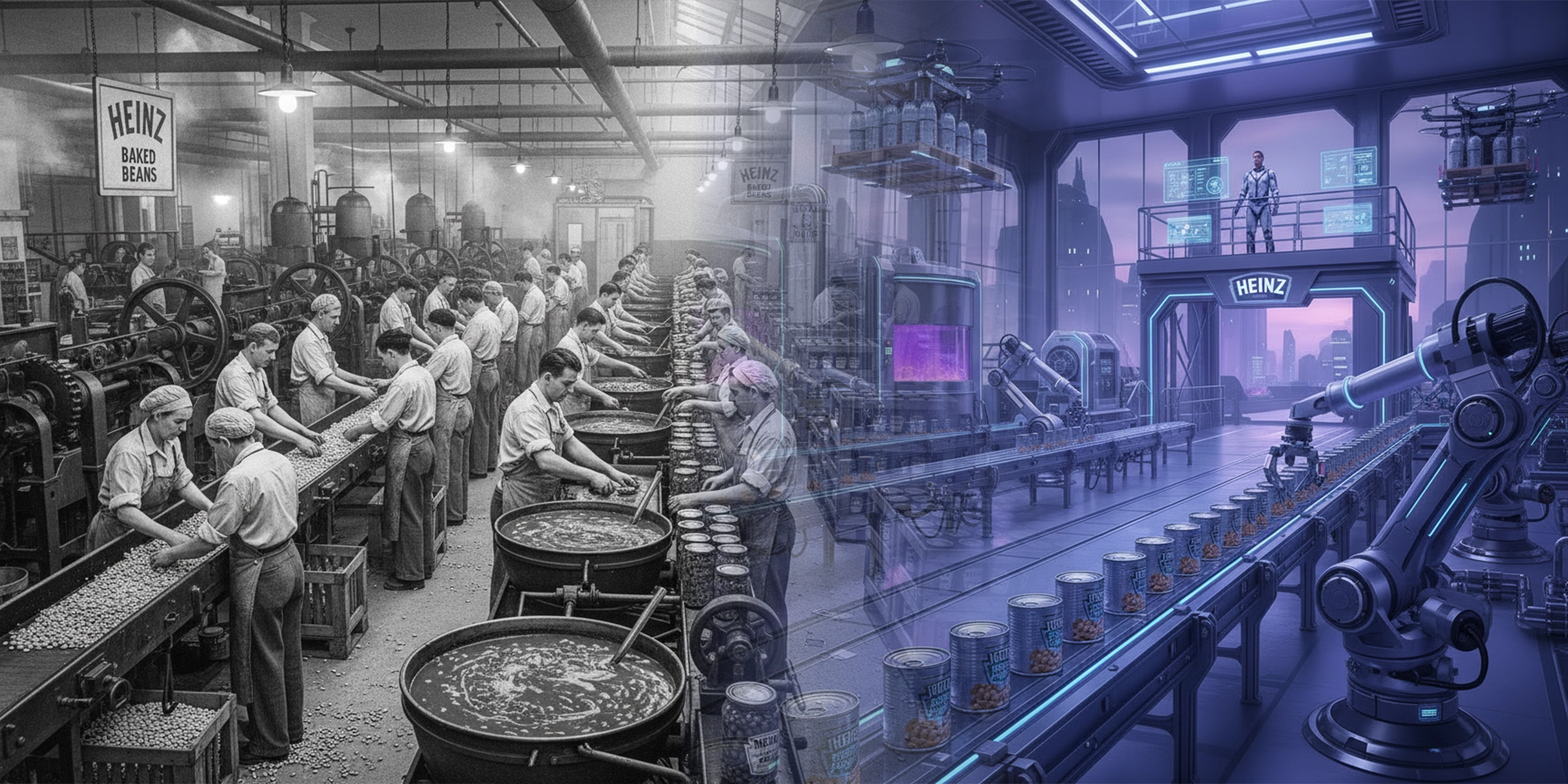
But let’s take a closer look at what it means when radical innovation doesn’t happen over generations but within a few years. A documentary on the Heinz factory in Wigam recently caught my attention. Yes, the “Baked Beans and Ketchup” Heinz. Manufacturing was the last major sector to be automated at scale, and now white collar work is next.
In the 1980s, the factory employed over 3,000 people. It dropped down to roughly 1,500 in the early 2000s, and then down to 850 by 2020. This is largely the result of automation: over that period, production output has increased manifold, and the range of products has expanded.
Now, employees rarely work on a single step of production, but instead monitor and control complex stages in the production with the help of automated systems and computers. Sounds a lot like what’s happening with white collar work in the age of AI, doesn’t it? Instead of doing tasks manually, the vision is to direct, control and monitor, rather than perform the task manually.
Let’s cut the bullshit and be real: what has happened to the Heinz factory will probably happen to virtually any company in existence. Companies will increase output and productivity, but the overall head count per company will very likely decrease, while the areas of responsibility of an employee will increase.
What this means for workers
On a grand scale, I’m convinced the new equilibrium will not significantly increase unemployment given today’s technologies. Instead, as unit costs decrease and output increases, business will become viable that previously couldn’t be profitable. These new businesses will create new demand for labor.
But on a small scale, this transition will hurt. There is real pain in giving up a position you’ve spent most of your life attaining. For anyone not able to transition smoothly, there will be pay cuts, and loss of self-worth and community.
Innovation can’t stand still. As the world around us changes, we can move forward or fade into insignificance, threatening jobs, quality of life, and living standards on an unimaginable scale. This is the fundamental tension: innovation is inevitable, but how we guide people through it is a choice.
Leading through change
As innovators, we should first undergo a shift in perspective. We should not downplay these human concerns as baseless fears or laziness. Instead, let’s view the resistance as a cultural immune system response. It puts up a fight against anything that could threaten the status quo. It slows down innovation and forces compromises so that change becomes digestible to society.
We should be thankful to some degree: while GDPR and privacy laws are a thorn in the side of progress, they have ensured that European societies have not turned into surveillance states and kept “being human” somewhat close to center stage.
Once we change our perspective, we can embrace the concerns more openly. Next, we need to revise our communication. Saying “we won’t automate your jobs, we’ll only augment them” may be true in the moment and reflect your current intentions, but it will fail the internal bullshit radar of any employee.
Instead, let’s be direct and acknowledge the fears: AI will dramatically change how we work, and some roles will inevitably be eliminated. The simple alternative is not adopting AI, which results in everyone being let go as the company fails to be competitive in the market. However, this is their personal opportunity to be part of this transformation and be among the first to find and define their role in this new world. Transformation is hard, but it’s far easier when people feel part of the story.
Show, don’t tell
As a company, you don’t own the narrative on AI. That narrative is created by the press, through conversations, and through every individual’s imagination. Your only real tool to counter is “show, don’t tell”. Start with tasks that are real pain points to your employees, be transparent how the use cases are chosen, what the solution may look like, and how it changes expectations of the roles. Offer insights and perspectives, the public discourse is vague, you can be concrete.
At long last, there will always be holdouts. When most people are on board, the new reality sets in, plans have been negotiated, and the company is committed to the change, some holdouts will continue to work against it. It is your responsibility towards your teams to ensure that these individuals are removed, as they can poison team dynamics and initiatives, leading to disaster for everyone involved. This isn’t about punishing doubt, it’s about protecting teams that are trying to adapt.
You don’t work against people for having fears. You go out of your way to work with them. Only when all constructive options have been exhausted is it time to wield the necessary power to move things forward.
Heinz wouldn’t employ 850 in Wigam today if it didn’t automate its factory floor. It would employ zero, and we wouldn’t be able to enjoy Heinz’s baked beans for breakfast. But you don’t win people over by force or by downplaying their fears. You win people over by listening and acknowledging, by being honest about the road ahead, and turning them into collaborators in the transformation, rather than victims of it.
Ready for AI your teams will embrace?
Key to "show, don't tell" is having a clear roadmap on how AI will reshape your organization from the ground up. At v9Labs, we help you come up with an action plan that not only addresses the technical challenges but also ensures your company is brought along for the ride.
Let’s build an AI strategy your teams can believe in.